



- THE PENSION SYSTEM: A MODEL FOR RUSSIA AND INTERNATIONAL EXPERIENCE
- Modeling the Pension System of the Russian Federation
- 11. The Funded Element of the Pension System
- Modeling the Pension System of the Russian Federation
11. The Funded Element of the Pension System
The size of funded pension depends on:
· the period of accumulation;
· the expected duration of the payment of pension;
· investment profitability,
and, since our concern is not the absolute but the relative (as compared to wage) pension size,
· wage growth.
Thus, the size of funded pension is directly determined by just one demographic indicator, residual longevity.
The current legislation does not yet regulate “the expected duration of the payment of labor old-age pension used to calculate the funded part of this pension”[1]. In this paper we shall, therefore, scrutinize different ways to determine this parameter. A variety of techniques are used in Russia’s and international practice:
1) Using the parameter equal to the estimate of residual longevity at the date of retirement depending on the pensioner’s age and gender. This technique is usually applied by insurance companies and non-public pension funds if the law does not qualify it as discrimination on the basis of gender.
2) In many countries, the legislation forbids using different residual longevity values for men and for women. In this case, average residual longevity for the men and women retiring at the same age is used.
3) The principle of equal residual longevity for men and women retiring at different ages (60/65), used for calculating NDC pension in Russia, should, strictly speaking, be qualified as discrimination against men.
The most important indicator describing funded pension is the replacement ratio at the date of retirement. Fig. 35 and 36 shows such replacement ratios calculated under “version 1”, that is, on the assumption that residual longevity is determined depending on the pensioner’s age and gender.
Let us first examine the replacement ratio for 2050. For the basic scenario, which assumes an unchanged retirement age and a 7% real profitability rate, we obtain an 11.3% replacement ratio for men and only 5.3% for women. Two factors determine this disparity:
· a shorter (by five years) accumulation period in the case of women; and
· much higher (almost 1.7 times) residual longevity among 55-year-old women as compared to 60-year-old men.
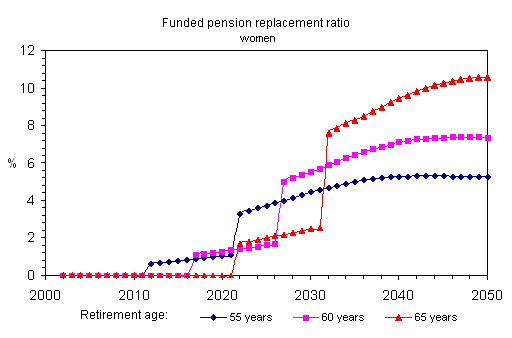
Fig. 35
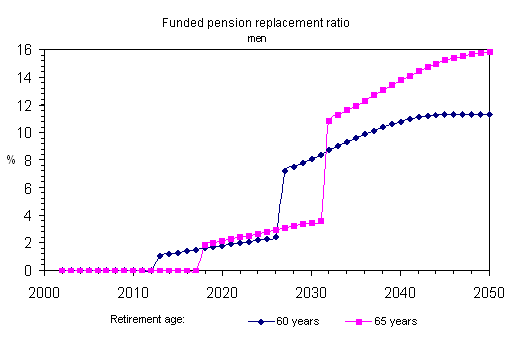
Fig. 36
Factoring in the same residual longevity for 60-year-old men and 55-year-old women (version 3), their replacement ratios would be 8.2% and 6.4%. Using the same residual longevity for men and women only on condition of equal retirement age (version 2) would produce the replacement ratios of 9.4% for men and 6.1% for women.
Let us now look at the charts in Figs 35 and 36 as a whole. At first sight, they may appear illogical: it would be natural to expect that for any age of retirement age, a higher figure should ensure a higher replacement ratio. The reason for this apparent lack of logic is that under the current law, the rate of contributions for funded pension depends on the person’s age in 2002. Let us take as an example the men retiring in 2030. If retirement age is 60, the persons accepting retirement in that year turned 32 in 2002; this is why their contribution rate is 6%. If retirement age is 65, the persons accepting retirement were 37 in 2002; their contributions rate is 2%.
The next step is to find out how the replacement ratio changes depending on investment profitability. To do this, let us lower the profitability rate by 1% a year, basing our calculations on 6% return. As a result, the replacement ratio would go down 1.19 times for men and 1.16 times for women. The disparity in the decrease is determined by the different length of the accumulation period. Generally speaking, the following regularity is revealed: under constant retirement age, a 1% change of the profitability rate causes the replacement ratio to change approximately 1.15 – 1.2 times. If retirement age were higher, making the accumulation period longer, the effect would be slightly higher.
Above, we examined only the basic demographic scenario. In terms of funded pension, this means, in fact, that to calculate pension size, basic residual longevity values are used. For the scenarios envisaging a high longevity increase, practically the only distinction would be the growth of residual longevity. Its higher values would result in a corresponding decrease of the replacement ratio. To evaluate the possible effect of residual longevity, let us note that under the high scenario, residual longevity exceeds the corresponding figures in the basic scenario by approximately 10%, and under the extra-high scenario, residual longevity is about 10% higher than this value in the high scenario.
In conclusion, let us base our modeling on the alternative wage growth rate forecast (Fig. 37). With the exception of wage growth, we used the basic modeling scenario (retirement age, 60/55; investment return, 7%). Under these conditions, in 2050 the replacement ratio for men will be 21.7%, and for women, 9.5%, as against 11.3% and 5.3% under the basic scenario. As an example, Fig. 37 presents the outcomes of the basic and the alternative scenarios for men.
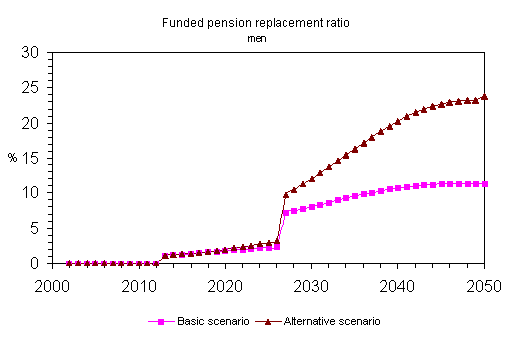
Fig. 37
The modeling prompts the following conclusions:
· The funded pension replacement ratio is strongly dependent on wage growth. Both the average growth rate and the form of the curve are important.
· The assumed high wage growth rate makes high demands on investment profitability. This makes it necessary to emphasize the regulation of the funded element of the pension system, which largely determines investment profitability.
By way of conclusion, let us note that legislative establishment of equal residual longevity in the calculation of pensions for men and women creates additional risks for the organizations which pay funded pensions. This fact must be borne in mind when drafting the legislation regulating this issue.
[1] Probably because the payment of the funded element of labor pension will begin only in 10 years.
