



- THE PENSION SYSTEM: A MODEL FOR RUSSIA AND INTERNATIONAL EXPERIENCE
- Modeling the Pension System of the Russian Federation
- 9. Macroeconomics and Investment Profitability
- Modeling the Pension System of the Russian Federation
9. Macroeconomics and Investment Profitability
The following macroeconomic indicators need to be projected to model the pension system:
· the rate of (retail prices) inflation;
· labor productivity and GDP growth; and
· average wage growth, often referred to as wage inflation.
It should be noted that by itself, inflation rate is required only in the calculations in nominal values (rubles). Considering that the least accurate forecast is that of inflation rate and that pension size in rubles in, say, 2023, means almost nothing, it would be much more informative to present the outcomes in today’s prices. To calculate such indicators, it is enough to know the real (minus retail price inflation) growth rates of GDP and average wage.
Long-term macroeconomic forecasting is a particularly complicated matter for Russia. As a rule, forecasting is based on long-term trends obtained as a result of analysis of previous experience and the assumption that these trends will continue to operate in future in an unchanged or slightly modified form. It is well known, however, that the trends of transition periods are unsuitable for long-term forecasting. Of course, this also makes it much more difficult to project the age and gender structure of the population, but for the macroeconomic forecast, this is an even greater difficulty (see Figs 25 and 26). In this situation, it would make sense to use other data, e.g., outside forecasts (including government ones), the trends/experience of other countries, etc.
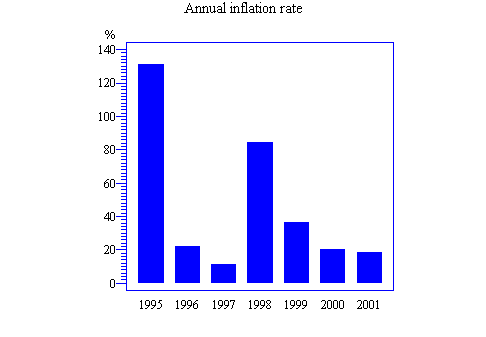
Fig. 25
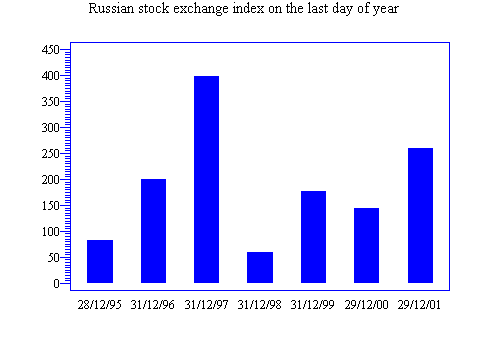
Fig. 26
For a variety of reasons, the views on Russia’s macroeconomic prospects are regularly revised. Thus, after President Putin’s criticism of the economic growth rates on which the government founded its plans, higher rates were factored into the 2002 macroeconomic forecast. As a result, a 6% average annual wage growth up to 2050 is currently treated as a realistic proposition.
What would this mean? Assuming that in the United States, this rate will be 1% a year, by 2050 the gap between Russia and that country would become 11.5 times smaller, and the average wage in Russia (in today’s prices) would be $1700 a month. Thus, at first sight, the expected wage growth rate appears realistic. There are, however, reservations.
1) How legitimate it is to compare the dollar worth of average wages in Russia and that in the United States? Since 1991, average wage in Russia rose dozens of times in dollar terms, whereas in real terms it almost halved. No one will question the fact that the dollar’s purchasing power in Russia and in the United States differs substantially and that the actual difference between the average wage in Russia and in the United States is much smaller than the ratio of their dollar values.
2) The forecast assumes a steady almost 50-year-long excess of wage growth rates over the increase of labor productivity by approximately 0.6%. It is not clear how such excess can be supported.
3) Disregarding the fluctuations, the main wage growth forecast assumes that in 2005 – 2020, average wage growth will approach 7%, will decline gradually over the next 10 years to reach 5.9% by 2030, and will subsequently go down by another 0.3% over the remaining 20 years of the forecasting period. To evaluate pension system effectiveness, it is important to determine how likely it is that wage growth will behave in this manner. Is not a more realistic scenario the one under which the initial wage growth rate is higher than under the above forecast as wages “emerge from the shadow”, the share of wages in GDP rises, and the incomes received from public funds in non-cash form are replaced by wages, and will then go down to the rate recorded in the advanced countries?[1]
In view of the above, the paper examines a supplementary wage growth forecast (see Fig. 27), which has already been used earlier to conduct similar calculations within the framework of the TACIS project[2] “Assistance to the Ministry for Economic Development and Trade. Project. Component 6. Pension Reform”. According to this forecast, average wage g rowth rate will be 3.5% a year.
Fig. 27
Investment profitability is a major parameter determining the effectiveness of the introduction of funded pension. It should be noted that in terms of the pension system generally, real return (over and above the rate of inflation) is more important. Another important factor is the excess of investment return over wage growth rate, since the latter directly determines the size of the contributions.
Like macroeconomic indicators, investment return is very difficult to forecast; it will largely depend on the practice of legislative regulation of pension investments. Above[3], we reviewed the history of returns on different classes of investments. These data demonstrate that there is no direct dependency between wage growth rate and investment return. Just the opposite, they rather confirm the assumption, based on the purchasing power parity curve theory, that real (e.g., stocks) investments have comparable long-term real profitability.
It should be remembered that investment profitability at the stage of accumulation and at the stage of pension payment might not be the same. This can be explained by the differences in the regulation of pension accumulations at these two stages, as well as the fact that the two processes may be managed by different financial institutes: accumulations may be the business of non-public pension funds, and pension payment, of insurance companies[4].[1] In the 1990s, wage growth rates in most advanced countries did not reach 2% a year. The Yearbook of Russian Statistics, RF Goskomstat, , 2001.
[2] A complete report on the project can be found in http://www.tacis-medt.ru/eng/pensref.htm
[3] Baskakov, V.N., Lelchuk, A.L., and Pomazkin, D.V., RF Pension System Model, Sotsialnyi vestnik, 2002, No. 3, pp. 3 – 35.
[4] See, for instance, a paper on the Polish pension system: A. Chlon, M. Gora, and M. Rutkowski. Shaping Pension Reform in Poland: Security through Diversity, Social protection discussion paper No. 9923, 1999, World Bank site.
