



- THE PENSION SYSTEM: A MODEL FOR RUSSIA AND INTERNATIONAL EXPERIENCE
- Modeling the Pension System of the Russian Federation
- 6.1.Old-age pensioners and length of service
- Modeling the Pension System of the Russian Federation
6.1.Old-age pensioners and length of service
The current legislation divides old-age pensions into the following main types[1]:
· regular old-age pensions;
· pensions assigned on the grounds of labor conditions;
· pensions for workers in the Far North;
· early privileged pensions unconnected with labor conditions;
· pensions for length of service;
· pensions assigned to survivors of radiation accidents and catastrophes;
· pensions for persons officially recognized as unemployed; and
· pensions for the deputies of the 1990-1995 convocation.
The type of pension actually assigned usually depends on the combination of the insured person’s age, general and specialized length of service, and type of occupation[2]. In terms of subsequent analysis, the significant distinction between these types of old-age pensions is that of actual or possible retirement age. Under the current legislation, retirement on account of old age may be possible starting with the age of 33, although most men may begin to draw an old-age pension at the age of 50, 55, or 60, and women, at the age of 45, 50, or 55.
The largest group of old-age pensioners is constituted by the recipients of regular old-age pension (68.1%), followed by the recipients of pensions connected with labor conditions (16.6%), workers in the Far North (6.4%), recipients of early privileged pensions not connected with labor conditions (6.1%), and the recipients of length-of-service pensions (2.3%). The recipients of the other types of old-age pensions taken together account for less than 1% of the total number of old-age pensioners.
The present age and gender structure of old-age pensioners was largely formed under the old pension and labor law (possible retirement age and operating restrictions for some categories of persons engaged in hard manual labor or working in hazardous conditions), as well as the employment sphere (the number of persons holding jobs entitling them to an early old-age or length-of-service pension).
By way of example, Fig. 11 presents the age and gender structure of male old-age pensioners as percent of the total number of men of relevant age. The age and gender structure of female old-age pensioners has a similar aspect. The rise of the number of pensioners is observed upon reaching the retirement age set under the law: 33, 45, 50, 55 and 60 years for men and 33, 45, 50 and 55 years for women (these ages are marked by vertical dotted lines on the charts).
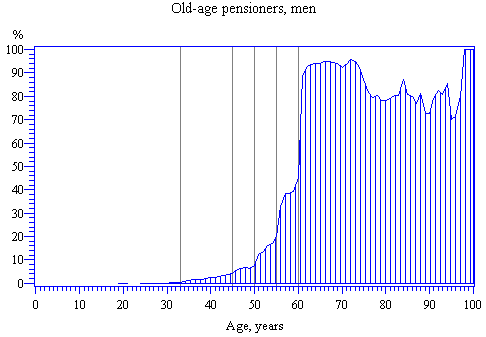
Fig. 11
In the older ages (over 60 for men and over 55 for women), the charts of the age and gender structure of old-age pensioners are not stable, although it follows from the analysis of the current pension legislation that after the onset of retirement age, the relative number of old-age pensioners should be constant. This inconsistency arises because the structure shown in the charts was formed under the old pension law and the features of the country’s development in the past century. The “leap” in the number of male old-age pensioners aged 60, and female old-age pensioners aged 55 was determined by two factors: first, the legislatively set retirement age for the largest category of old-age pensioners, recipients of a regular pension, and, second, the fact that upon reaching retirement age, a number of disability pensioners who had the required length of service switched over to regular old-age pension[3]. For disability pensioners, the switch had direct economic sense, since the old-age pension is usually about 40% higher than the disability pension (according to the RF Pension Fund, as of March 31, 2001, the average size of these pensions was 1441.89 and 1062.56 rubles respectively). In our estimate, the rise of the number of old-age pensioners of retirement age is accounted for by the change of pension type in 10% of the cases as regards men, and 7% of the cases as regards women. Under the new pension law, such transition has no economic sense: a change of pension type does not entail a recalculation of the NDC and funded pensions, and the basic pension can be raised only if the pensioner has a category 3 restriction of capacity for work (it is irrelevant whether he/she draws an old-age or a disability pension).
The number of old-age pensioners goes down after the age of 70, although not in the same way among the men and among the women. In men, it occurs due to the onset of disability: in this age, the share of category 1 and 2 disability pensioners sharply increases. As regards women, there is an increase in the number of survivor and social pension recipients. An explanation can be found in the past (the generation who are now over 70 are a wartime generation), so there is no reason to assume that this situation will repeat itself. A good illustration is analysis of the number of women who draw a social pension. Let us note, first of all, that the size of social pension is minimal, so that switching over to it from any other pension is economically senseless. Consequently, the new recipients of social pension are those who have not drawn any pension before. But there are practically no such women aged 55 – 70, which means that the number of female social pensioners will not increase in the future.
The number of disability pensioners may, in theory, rise in the older ages because this is when the share of disabled persons rapidly increases. This scenario is, however, unlikely, since the current pension law does not offer economic grounds for switching over from an old-age to a disability pension. At present, all the social benefits are tied to the very fact of disability, not to the type of pension. It can, therefore, be assumed that in the future, the share of old-age pensioners will remain constant.[1] This list of old-age pensions is far from complete. Many types of pensions in it allow of further classification.
[2] In a number of cases, the type of old-age pension many be changed.
[3] The Disabled in Russia: Disability Causes and Dynamic and the Controversies and Prospects of Social Policy, // T.M. Maleva, S.A. Vasin, O.Yu. Golodets, and S.V. Besfamilnaya, Bureau of Economic Analysis, Moscow: ROSSPEN, 1999, 368 pp.
