



- THE PENSION SYSTEM: A MODEL FOR RUSSIA AND INTERNATIONAL EXPERIENCE
- Modeling the Pension System of the Russian Federation
- 4. RF Pension System Model
- Modeling the Pension System of the Russian Federation
4. RF Pension System Model
This chapter contains a concise description of the RF pension system model designed by Independent Actuarial Analytical Center (IAIAC). Work on the model began with a study of international experience in this field, first of all, the World Bank PROST program drafted for the study of the financial state of the pension systems of the countries introducing pension reform and the International Labor Organization “Social budget” program designed to forecast the financial flows in the social sphere.
The PROST model was used to model the financial state of Russia’s pension system since 1996. However, it eventually became clear that this model is not quite adequate to the needs of actuarial examination of the RF pension system under radical reform. We were aware of this in 1997- 2001 when making actuarial calculations for the RF Government as pension reform was being prepared[1], and when conducting independent actuarial examination of government decisions on pension provision for various social and demographic population groups[2]. The team of RF State Pension Fund experts who are working on a pension fund model reached the same conclusion[3].
Any imitation model of a pension system must meet one fundamental demand, namely, be adequate to the operating and/or planned pension legislation. Specifically, it must provide an opportunity to model the pension contributions and payments differentiated by pension type (basic, NDC, and funded) and the principal social and demographic groups whose pension provision has specific features under the law or de facto, e.g., wageworkers and the self-employed, old-age and disability pensioners, early pensioners, etc. If this condition were not met, it would be pointless to talk about a pension system model (hereafter, it is tacitly assumed that the model is fully in line with the current legislation). At the same time, to meet this condition by using a model whose development disregards the concrete circumstances is extremely difficult: any changes in the pension system cause the need to change their program code. This was the main reason why these models did not become popular enough, and provided a stimulus for developing a new model.
Drawing on the practice of imitation modeling, we formulated the additional demands to the future pension system model, which the available models do not fully meet. They include flexibility and user friendliness, the ease of adjusting the model to different scenarios and organizational patterns of the pension system itself, and availability of different report formats. But we also made a point of using the valuable aspects of the existing systems, specifically, the most efficient solutions and calculation algorithms that have already been tested in the PROST and Social budget models.
IAIAC began work on the model in 2000. At its different stages, the project was financially supported by the MPSF (and USAID), the RF Ministry for Economic Development and Trade, the Soros Foundation, and the Russian Social Reform Fund.
At all stages of the modeling, we had an opportunity to use the advice and recommendations of Jean-Noel Martineau and other international experts and consultants thanks to the World Bank, USAID, ILO, and the TACIS Program of the European Union[4]..
Any model is merely a simplified description of reality whose adequacy depends on the quality of the assumptions and premises. The main assumptions of our model pertain to the forecast of demographic and macroeconomic indicators. For economies in transition, of which the Russian Federation is one, the problem of long-term (up to 50 years and even more) forecasting is complicated by the impossibility of using demographic and macroeconomic trends as the forecast basis.
The significant uncertainties as regards the value of the principal model parameters makes it necessary to examine the pension system stability to their changes, including analysis of the model’s sensitivity, which made it necessary to vary the values of a large number of model parameters (indexation of all types of pensions, investment profitability, retirement age, tax/contribution rates, and others). This largely determines the standards set to the structure of the model and the service, especially when it comes to input data formation, variation of model parameters, and report formats. In addition, the construction of the pension system legislative framework is not yet completed, which means that the model must leave room for prompt tuning necessitated by the expected changes in the legislation.
The architecture of the program described in this paper took into account the standards formulated above: our goal was to provide an instrument for actuarial examination of a broad range of pension system versions. We used the module principle in the programming, under which the model can be divided into the following logical blocks:
· the macroeconomic block, to determine the wage level depending on macroeconomic assumptions and the labor market forecast;
· the demographic block, to determine the time-dependent age and gender composition of all groups of payers and pensioners;
· the revenues block, to calculate the total contributions made by each group for the different types of pension, and to calculate the accumulated benefits; and
· the expenditures block, which makes it possible to calculate the size of paid pensions and the summary volume of payments for each group of pensioners and each type of pension.
These blocks are standard functional elements in this class of models. When designing them, we used the above-described basic principles of financial and actuarial mathematics adapted to the RF pension legislation. Two supplementary blocks were added to make the system flexible and user friendly, and the presentation of the obtained outcomes full and clear:
· preparation of the scenario of calculations and input data (values of model parameters); and
· report drafting.
The model consists of several Excel working books with macros at generally accessible VBA interpreter for Excel united into a single integrated system, which makes it easy to be used by a broad range of users both in terms of modeling and analysis of the input data and the used algorithms. The core of the system is the model.xls book, which is, in fact, the executive program, which contains VBA interface forms and codes of the principal algorithms.
The main form of the model.xls book is presented in Fig. 3. It gives the user an opportunity to select the previously designed pension system development/reform scenario, modify it, build a new scenario, activate the system blocks described above, examine the outcomes of the calculations, and draft an output report.
The data of the basic pension system development scenario can be found in the electronic tables united in the datareform.xls book. This book also incorporates the outcomes of calculations for individual sub-scenarios[5] with a full range of the values of all parameters of the system’s adjustment used to make the calculations. This option makes it possible, first, to conduct a comparative analysis of the outcomes of calculations for individual scenarios using both the opportunities provided by the system itself (see below) outside programs; and, second, to make a second calculation (if need arises) for any previously saved scenario having a guarantee that the same result will be obtained.
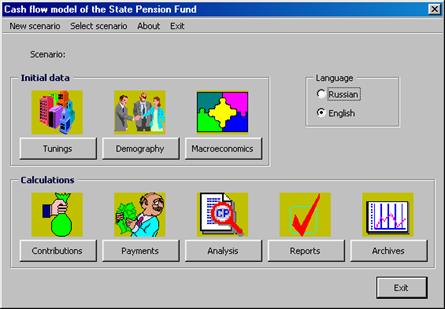
Fig. 3
The system provides an opportunity to create supplementary scenarios as Excel books named data*.xls similar to the datareform.xls book, which store the relevant information. The simplest way to create a new scenario is to modify the basic (or any other) scenario and save it under a new name. The modeling system provides a special instrument, makeID.xls, which enables the user to load outside input data arrays, including the data of outside demographic and macroeconomic forecasts, to the data*.xls book.
The input data contain demographic and macroeconomic forecasts and pension system parameters. The RF pension system model described in this paper incorporates a block, which forecasts population size[6]. Its algorithms, which use the standard age shift with migration technique, are practically the same as those employed by the RF State Statistical Committee. This makes it possible to introduce into the model any assumptions on the basic parameters of the demographic forecast.
1. Fertility: total fertility rates and the mother’s average age at the birth of a child.
2. Mortality: expected longevity at birth for men and women, as well as infant mortality.
3. Migration: total number of persons leaving and entering the country.
The model may also use outside demographic forecasts.
To identify the payers’ and recipients’ groups and determine their size, we used the share matrices containing the percentage ratio of the given group to the given category or the population at large. Share matrices have the dimensionality of demographic matrices, which provides an opportunity to model the payers/recipients ratios in time. Forecasting the share ratios of individual groups is a more complicated matter, which calls for the introduction of supplementary assumptions and hypotheses lying outside this model. The number of payers is determined proceeding from the size of employable population; to estimate it, we need to set the employment and unemployment rate for each gender, age, and forecasting year.
The macroeconomic forecast comprises one-dimensional time series and includes such values as the wage, inflation, and DGP growth rates.
The supplementary pension system parameters include retirement age, contributions rates, collection rates in time, etc. Most system parameters are set as one- or two-dimensional arrays. Thus, payers of different ages currently make contribution under different rates, which depend on the forecasting year and the payer’s age; the contribution rate array is also prepared as a two-dimensional matrix. Although the storage of input data as matrices somewhat overburdens the system (in Excel, the procedure is, however, easy), this inconvenience is more than made up for by the resultant high flexibility of the model and the opportunity to adjust it to practically any pension system reform version.
Many model parameters can be varied directly from the model.xls book using the system-tuning block, which comprises the following elements (see Fig. 4):
· Basic parameters
· Indexation
· Social groups
· Options.
Among other things, this block enables the user to employ the automated regime to scan through the group of pension contribution payers and recipients set in the selected scenario and the basic parameters of the selected pension system development scenario, and, whenever necessary, to change some of them, setting the parameters of wage indexation (separately for wageworkers and the self-employed) and pension indexation (basic, NDC, funded, early, etc.). Indexation may be to wage growth (W), consumer prices inflation (CPI), fixed interest rate, or any combination of these parameters. In the general case, indexation is determined under the formula:
(1+ а*Inflation) * (1+ b*W_ growth)*(1+с),
where W_growth is real wage growth (over and above CPI); and
а, b,сareparameters.
The model also provides for introducing an outside vector index and setting a number of supplementary parameters.
To make the model even more flexible and ensure prompt access to input data and the results of calculations, the information exchange between individual blocks of the system takes place though a data exchange buffer, which is an ordinary Excel list.
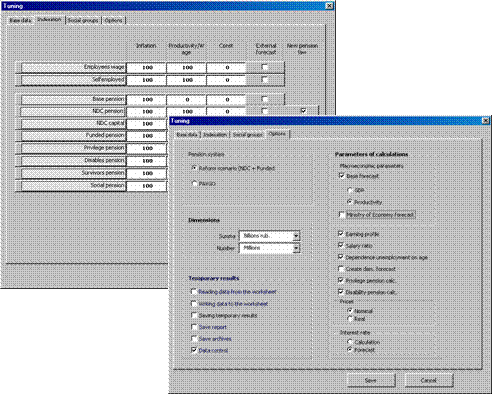
Fig. 4
This data exchange organization has a number of advantages. First, all the input data of the given pension system development scenario and the results of calculations (including intermediate ones) are stored on separate lists, which provides prompt access to them (the input data of the model comprise more than 100 two-dimensional arrays with a dimensionality of 100x50 and approximately 60 one-dimensional arrays). Second, the user is able to intervene into the modeling process at any stage to make changes into the data (input or intermediate), thereby altering the scenario with a minimum outlay of time and changes in the program.
The next stage in the work of the system is loading the selected demographic and macroeconomic development scenario and calculating the required derivative parameters. The program makes it possible to scan through the demographic and macroeconomic data presented as tables and charts (see Fig. 5).
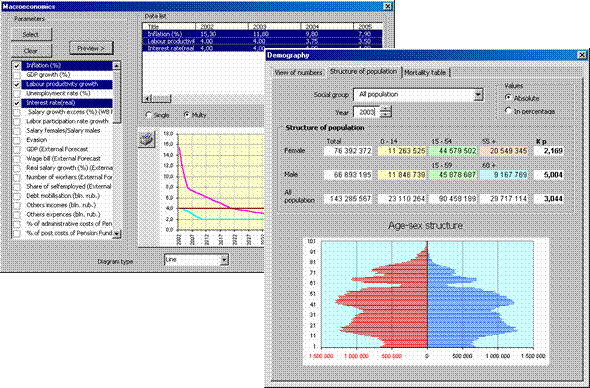
Fig. 5
An important element of the model is the reports block. In view of the large volume of output information (more than 450 time series), the model provides for three main formats for the presentation of the obtained outcomes, which enable the user to conduct detailed, summary, and comparative analysis both as tables and as charts.
Detailed analysis helps scan through the intermediate calculations and obtain access to any element of the array used in them. The data can be scanned presented as tables or charts. In the latter case, one can build a variable against both the age of the group and the forecasting year; for instance, male wageworkers’ contributions to the funded element of the pension system against age in the year 2024, or the number of 60-year-old males receiving an NDC disability pension against the forecasting year (see Fig. 6). One can also build a chart with two independent variables, age and forecasting year.
The summary form was designed so as to present the main outcomes and helps to quickly build the desired report format by automatically arranging the output data in the required order. One can also document the outcomes by including headings and commentaries.
To speed up the search for the desired calculation outcomes, we added filters selecting the outcomes that meet the set conditions, e.g., the number of pensioners, by groups, who draw different types of pensions. To build such a sample, four conditions need to be set (see the opening lists when the “Analysis” option is selected, Fig. 7): gender (no option, which means both genders), parameter (pension types, all, which means all types of pensions), the desired parameter (number, pension size, replacement rate), and pensioner group. The technique for report production used in the model is analogous to the client – server system, when the user works with the database through a system of queries. Historically, such models use a consecutive architecture, step-by-step calculations and report formations. Our model provides for both a standard and a parallel architecture analogous to the client – server system
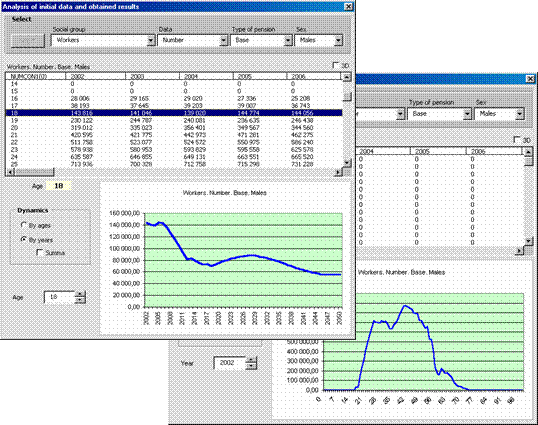
Fig. 6
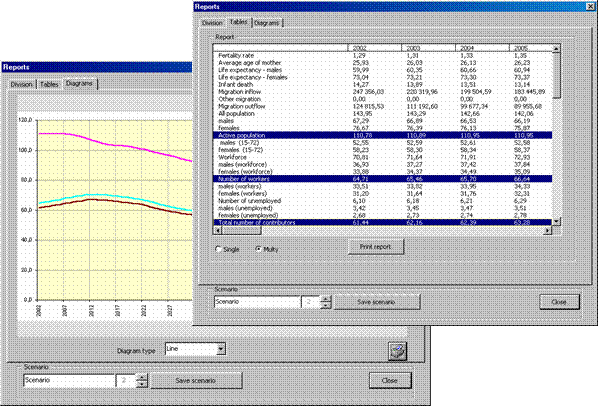
Fig. 7
The comparison of scenarios, which are called from the main form by pressing the “Archive” key, is intended for promptly comparing the modeling outcomes. The form is shown in Fig. 8. It is build analogously with the “Report” form, the difference being that comparative analysis involves the same indicators calculated for different scenarios. This form enables the user to assess the sensitivity of the modeled system to input data changes. This option raises the accuracy of calculations under different scenarios and the flexibility of the model.
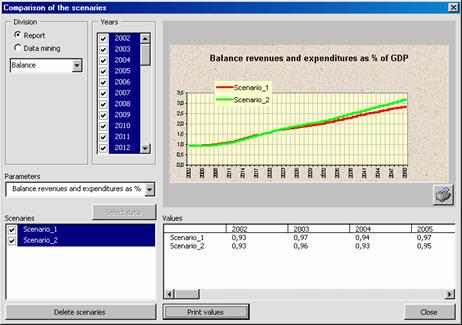
Fig. 8
[1] Dmitriev, M.E., Pomazkin, D.V, Sinyavskaya, O.V., et al, Pension Reform in Russia. Transactions of the Institute for Economies in Transition, No. 11R, 1999.
[2] Baskakov, V.N and Baskakova, M.E., On Pensions for Men and Women: The Social Aspects of Pension Reform, Moscow: Moskovskii filosofskii fond, 1998.
[3] Solovyov, А.К., Burnashova, R.A., et al, An Actuarial Model of the Pension Fund: Construction Principles to Deal with Pension Reform Issues in 2002, VestnikPFR, No. 3, 2001.
[5] As a rule, the data of individual sub-scenarios differ as regards the value of parameters which can be changed using the options offered by the system itself (e.g., indexation rate, some demographic and macroeconomic parameters, etc.), or can be loaded from an outside file (e.g., an outside demographic or macroeconomic forecast).
[6] Developed by E.M. Andreev.
