



- THE PENSION SYSTEM: A MODEL FOR RUSSIA AND INTERNATIONAL EXPERIENCE
- Modeling the Pension System of the Russian Federation
- 10. The PAYGO Element of the Pension System
- Modeling the Pension System of the Russian Federation
10. The PAYGO Element of the Pension System
Above, we examined a purely demographic indicator, old age dependency ratio, which helped us to discover important relationships and formulate demographic scenarios for further study. The merits of the purely demographic old age dependency ratio is that it does not depend on a country’s pension system and makes cross-country comparisons easy. This merit is, however, also its fault, since real dependency is determined by the number of pension recipients and pension contribution payers.
Fig. 28 shows the number of pensioners drawing a labor pension and the number of employed persons, making it clear that if the basic forecast is realized, by 2050 the number of pensioners and of the employed will become equal, that is, there will be one pensioner for one employed person.
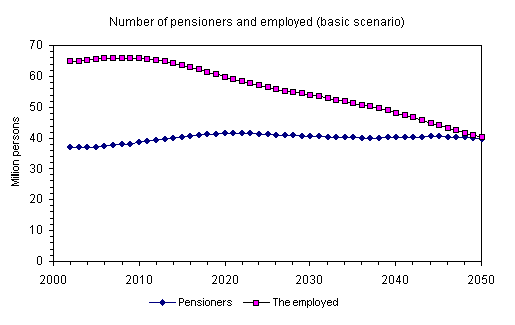
Fig. 28
Let us look at another indicator, pensioner dependency ratio (for the system), which is the ratio of the number of labor (old-age, disability, and survivor) pension recipients to the number of the employed (see Fig. 29).
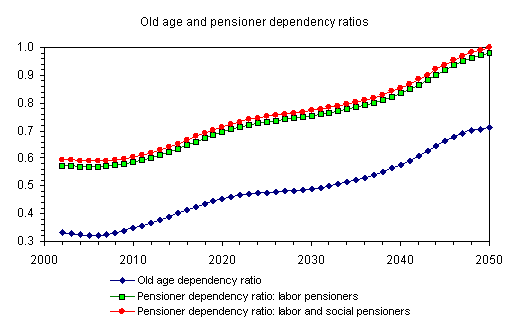
Fig. 29
Fig. 29 shows that the pensioner dependency ratio, which factors in, along with the labor pension recipients, those who draw a social pension, is very close to the ratio which factors in the labor pensioners alone. So, to simplify the presentation, we shall exclude the social pensioners from subsequent analysis.
To measure the effect of the number of early (privileged) pensioners on the pensioner dependency ratio, these ratios under the basic demographic scenario and constant retirement age were calculated for the following versions:
- the current number of early pensioners remains unchanged (as percentage of the corresponding age and gender groups);
- gradual reduction of the share (percentage) of early pensioners in conformity with the current legislation; and
- no early pensioners.
Our calculations demonstrate that the effect of the institute of early (privileged) pensioners on the pensioner dependency ratio is not great. Total disregard of this institute decreases the ratio:
· by 4 – 6% from the version under which the current number/share of early pensioners remains unchanged; and
· by 1.5 – 2% from the share envisaged by the current legislation.
Let us now scrutinize the correlation of the pensioner dependency ratio with one of the most important pension system factors, retirement age. As before, we shall consider the present retirement age, 60 years for men and 55 years for women, designating it 60/55 (Fig. 30), and two possibilities of its rise:
· 60 years for both men and women (60/60); and
· 65 years for both men and women (65/65).
Comparing the pensioner dependency ratios under different demographic scenarios and retirement ages, Fig 31 shows them as percentages of those ratios for present retirement age. Analysis of Fig. 30 and 31 reveals that:
· for all considered demographic forecasts, raising retirement age to 65 years would decrease the pensioner dependency ratio by 35-40%;
· if retirement age is raised to 65 years, under the basic demographic scenario the pensioner dependency ratio will reach the 2002 figure only in 2050; under the basic birth rate and extra-high longevity scenario, this will happen by 2040, and under the extra-high birth rate and basic longevity scenario, the current figure will not be reached by 2050; and
· in 2050, the pensioner dependency ratios under the two mixed demographic scenarios differ approximately 1.35 times.
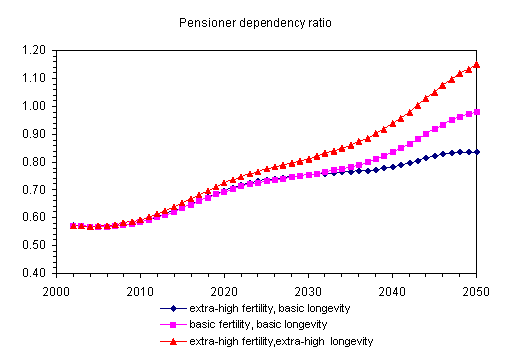
Fig. 30
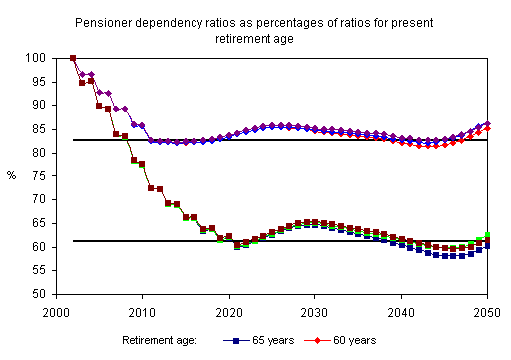
Fig. 31
When modeling, retirement age was raised by one year for two calendar years; this is why, Fig. 31 shows a transition period (10 and 20 years respectively should retirement age be raised to 60 and 65 years), during which the percentages strive towards a stationary value. The same is also true for some other outcomes (see Fig. 33).
To evaluate pension system efficiency, different criteria may be used depending on the situation and/or the set goal. In the current situation with its low standard of living, one of the principal criteria is achieving the subsistence minimum. Since we are looking at long-term prospects, this criterion is not so important; the main criterion of pension provision is the replacement ratio, that is, pension/wage ratio.
As is known, this criterion is based on the following simple premises. Assuming that a person accepting retirement is not worried about poverty, it is believed that after retirement, he/she will need less money to maintain an unchanged standard of living. Why is that so? Because by the time of retirement, this person:
· already has grown-up children who can provide for themselves;
· has returned the loans taken earlier (e.g., for the purchase of an apartment or dacha);
· has ceased to save for the pension, etc.
The replacement ratio allowing to keep up the standard of living unchanged will, therefore, be under one. In the advanced countries, the optimal replacement ratio is accepted as 60 - 70%. The ILO recommends the replacement ratio should not be below 40%.
Under the current pension system, labor old-age and disability pension comprise the basic, the NDC, and the funded elements, with the former two being elements of the PAYGO system. It should be noted that by themselves, the basic and the NDC elements are just a way to calculate the PAYGO part. Their introduction has no direct effect on the opportunities opened up by the PAYGO system[1]. In each forecasting year, the effectiveness of the PAYGO system is determined by the volume of pension contributions/number of pensioners ratio.
The basic indicator describing the potential of the PAYGO part of the pension system is the PAYGO affordable replacement ratio. It is equal to the ratio of the average size of the PAYGO element of labor pension (i.e., the sum of the basic and the NDC elements) in a certain forecasting year to average wage in the same year, provided that the sum of the payments for the basic and NDC elements of the pension is equal to the sum of the contributions for the basic and the NDC elements. The affordable replacement ratio for the three demographic forecasts is presented in Fig. 32, and the effect of a higher retirement age on the value of this ratio is illustrated in Fig. 33, which shows the these ratios obtained with account of raised retirement age as percentages of the ratios obtained under the current retirement age for the three demographic forecasts. The modeling demonstrates that raising retirement age for women to 60 would result in a relative increase of the affordable replacement ratio by an average of 20%, and raising retirement age for men and women to 65 would increase this ratio by an average of 65%. The effect of the demographic forecast on the examined parameter is insignificant; its variation with respect to the average value can probably be explained by the demographic waves in the age and gender structure of the population[2]..
The modeling also shows that for the combined scenarios determining the range of variation, in 2050, using the same retirement age:
· the old age dependency ratio differs about 1.5 times;
· the pensioner dependency ratio differs about 1.35 times, and
· the correlation is the same for the PAYGO affordable replacement ratios.
In all cases, the indicators for the basic demographic scenario lie somewhere in the middle, with the difference of the affordable replacement ratios from the basic scenario not reaching 20%.
If retirement age is raised, the share of the employed increases, and the share of pensioners goes down[3], which sharply reduces the pensioner dependency ratio, leading to a rise of the PAYGO affordable replacement ratio. In terms of PAYGO pension, the rise of retirement age lengthens the period of accumulation and shortens the period of pension payment, with the latter factor much more significant than the former.
If retirement age is raised to 65 years for both men and women, in 2050:
· the old age dependency ratio will go down 1.8 - 1.9 times;
· the pensioner dependency ratio will do down approximately 1.6 times, and
· the PAYGO affordable replacement ratio will change in about the same measure[4].
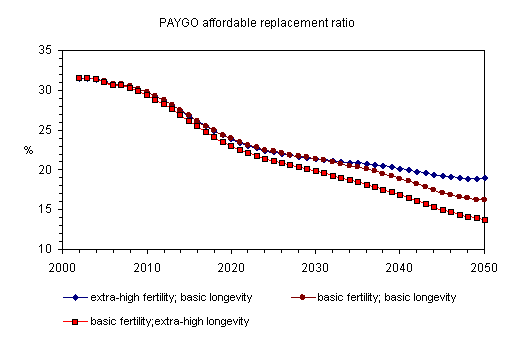
Fig. 32
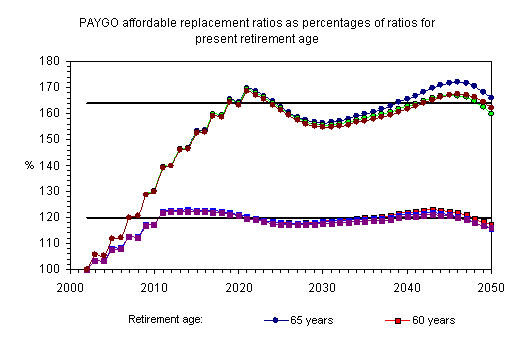
Fig. 33
Indexation (basic scenario)
Above, we examined the indicator describing the general potential of the PAYGO element of labor pension. But the affordable replacement ratio says nothing about the size of the basic and NDC elements of labor pension calculated under the current legislation, the payment of which may result in a deficit or surplus of the balance of the PAYGO element of labor pension.
In accordance with the current legislation, the basic part of labor pension is indexed to inflation rate. At the same time, the Law on Labor Pensions in the Russian Federation (paragraph 6, Art. 17) says that “along with indexation, the basic parts of labor pension … may be established by individual Federal laws with a view to gradually bringing them up to a pensioner’s subsistence minimum”. Obviously, in terms of modeling, there is no difference between indexation and establishment “by individual Federal laws”, so in future, we shall refer to indexation alone.
Above, we said that the macroeconomic forecast assumes a high wage growth rate. As a result, owing to indexation to inflation, by 2050 average basic pension will be only 0.7% of average wage, that is, in the case of such indexation principle, the basic element of labor pension strives towards zero (see Fig. 34).
Under the current legislation, the NDC element of labor pension is indexed, roughly, to wage growth but not at a higher rate than “the rise of the RF Pension Fund per pensioner revenues directed to the payment of the NDC part of labor pension”. In conformity with Art. 18 of the Federal Law No. 167-FZ “On Mandatory Pension Insurance in the Russian Federation”, these revenues include “the money accumulated as a result of the excess of the sum of revenues from the single social tax (contribution) as regards the part received by the Federal budget over the expenditures on the funding of the basic element of labor pension …».
The NDC element of labor pension calculated on the basis of indexation prescribed by the Law (when the basic part of labor pension is indexed to inflation) is presented in Fig. 34. It shows quite clearly that the sum of the basic and NDC elements of labor pension very quickly become much smaller than the PAYGO affordable replacement ratio, that is, a large surplus appears.
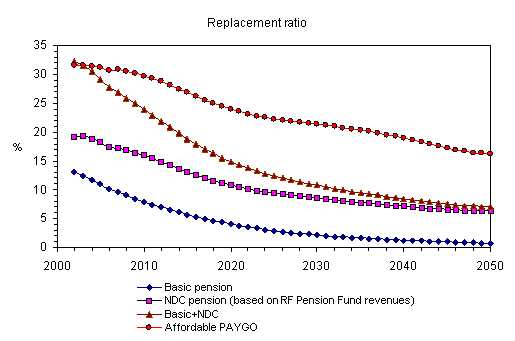
Fig. 34
When calculating the size of NDC pension shown in Fig. 34, indexation was conducted without account of basic pension surplus. This indicator provides the bottom boundary of the possible outcome. The ceiling can be obtained with the help of indexation to wage growth rate; however, even this mode of indexation makes for a large PAYGO surplus.
The effect of residual longevity
It is easy to see that the PAYGO affordable replacement ratio does not directly depend on residual longevity, which operates indirectly through the pensioner dependency ratio. Since, as was shown above, the values of this ratio for the basic, high, and extra-high scenarios[5] are very similar, their affordable replacement ratios are also close. At the same time, residual longevity may affect the design size of the NDC element of labor pension. Thus, it follows from Fig. 23 that for retirement age of 60/55, average residual longevity under the extra-high forecast exceeds that under the basic scenario by approximately 20%. Therefore, even with the same affordable replacement ratio, the size of NDC pension may differ.
[1] It is assumed that the introduction of the NDC element will provide a stimulus to the payment of contributions, thereby, indirectly affecting the PAYGO system.
[2] In the beginning we also see the effect of gradual transition from the present retirement ages to the new retirement ages (see comments to Fig. 31).
[3] The modeling factors in the increase in the number of disability pensioners.
[4] This outcome holds for different retirement ages.
[5] I.e., the scenarios where basic, high, and extra-high birth rates are combined with the same longevity indicators.
