



1. Preface
V.N. Baskakov, A.L. Lelchuk, and D.V. Pomazkin,
Independent Actuarial Information Analytical Center
Modeling the Pension System of the Russian Federation[1]
1. Preface
Pension system modeling is the basic element of actuarial examination[2].
In the general case, actuarial examination implies that a trained actuary analyzes issues that are relevant to the operation of the given country’s pension and/or insurance system and that involve future financial risks and uncertainties using specialized knowledge of applied mathematics, economics, finances, statistics, demography, and management.
In the presence of crises accompanied by a deterioration of the economic, social, and demographic situation and other undesirable processes which periodically occur in Russia, it is much more difficult to make effective decisions: the prevailing situation needs to be objectively evaluated so as to find effective solutions. This poses a natural question: is a society in the state of social and economic flux really doomed to a delayed response to the arising risks, factoring them in when they are more or less obvious? In our view, it is high time we tried to develop preemptive responses, which would go into action not after but before the risk has become evident. The following factors pave the way for adequate measures of this kind in the sphere of insurance:
1. Any insurance schemes and technologies are a source of risk for the various subjects of insurance, be it the policyholder,, the insurer or the insured (see below); many of these risks are usually known apriori.
2. These risks and their undesirable consequences often prove unexpected not because it is impossible, in principle, to predict them but because when the laws and statutes regulating the given type of insurance were being drafted, adequate steps were not taken.
It follows that today, under a radical reform of the pension system and the entire sphere of social insurance, we need to make a systematically organized effort to predict the risks posed by the introduction of new and the use of old insurance schemes and technologies, namely, provide complex analysis of both the draft laws and draft legislative resolutions and decisions on insurance and pension provision. In our view, the core of this effort should be constituted by actuarial examination as a necessary part of the general examination (juridical, ecological, gender, etc.) of government draft decisions.
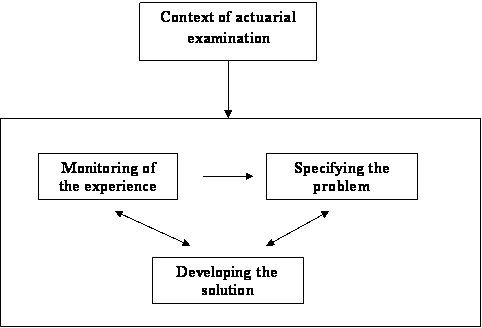
Actuarial examination rests on the Actuarial Control Cycle[3] proposed in 1985, which is a particular case of the general control cycle used in all business spheres. The main stages of the actuarial control cycle adapted to actuarial examination of Russia’s pension system are:
0) Preliminary stage (the context of actuarial examination)
It involves a study of the overall economic, commercial, social, and demographic environment in which the RF pension system functions, that is, a study of the “context” of actuarial examination.
1) Specifying the issue
The main substance of this stage is identification and assessment of the risk facing all the participants in insurance and determining the risk factors and the possibility of risk reduction/redistribution. The findings of risk analysis help specify the goals of examination and set the criteria of assessment of the obtained outcomes.
2) Developing the solution
The main task of actuarial examination of the country’s pension system is to assess the expected outcomes of the latter’s performance from the stand of the interested parties. At this stage, the actuary examines the possibility of using the available models in dealing with the tasks facing him/her and, whenever necessary, adjusts them and/or develops new ones. The actuary then proceeds to analyze the available data (demographic, macroeconomic, etc.) and sets the values of the model parameters, possibly using non-formal techniques, since the exact values of many parameters, especially ones connected with forecasting, cannot be determined.
3) Monitoring the outcomes
The next stage of actuarial examination is the monitoring of indicators relevant to the pension system. At this stage, the actual outcomes of the system’s performance is summed up and compared wit the expected one. The findings of the monitoring may pose the need to more exactly formulate the task and/or the way of tackling it. This necessitates going back to a revision of the stages of the work, and the control cycle is closed.
Note. An important element of monitoring is identifying the reasons why actual outcomes differ from expected ones.
The actuarial control cycle is schematically presented in Fig. 1. The double arrows indicate the presence of feedback.
[1] The Russian-language version of this paper allocates a great deal of space to the analysis of international experience and the possibility of its use when introducing pension reform in the Russian Federation. In the English translation, some information well known to English speakers was replaced by a more detailed analysis of Russia’s pension provision and its long-term development prospects.
[2] V. Baskakov, A. Lelchuk, and D. Pomazkin, The Pension System of Russia: Actuarial Examination (methodological approach). Sotsialnyi vestnik pensionnykh i sotsialnykh fondov stran SNG i Baltii, 2002, No. 1-2.
[3] Goford, J. The Control Cycle: Financial Control of a Life Assurance Company / Presented to the Institute of Actuaries Students’ Society on 12th February 1985.
