



- THE PENSION SYSTEM: A MODEL FOR RUSSIA AND INTERNATIONAL EXPERIENCE
- Modeling the Pension System of the Russian Federation
- 6.2.Disability pensioners
- Modeling the Pension System of the Russian Federation
6.2.Disability pensioners
Number of disability pensioners
Current legislation divides the disability pensioners into the following main categories:
- due to a general disease;
- due to an industrial injury or occupational disease; and
- due to radiation accidents and catastrophes.
The largest group of disability pension recipients are persons disabled in consequence of a general disease (95.4 %), followed by those disabled by an industrial injury or occupational disease (4.3%), and the persons disabled in consequence of radiation accidents and catastrophes (0.3%).
Not all disabled persons by far are recipients of (labor) disability pension. In the younger ages, this happens because disability pensions are assigned only to persons who used to have a job regardless of the general length of service. In theory, a person may be assigned disability pension upon turning 15, but will begin to actually receive it at the age of 17 (see, for instance, Fig. 12). Before this age, disabled persons usually draw a social or a survivor pension. Most employable age disabled receive a disability pension because, if a person disabled since childhood got a job (according to statistics, this happens after the age of 17), the old pension system made it worthwhile to switch from the previously assigned social pension to a disability pension. A person disabled in employable age has no alternative but to apply for a disability pension. In this age, the number of disability pensioners is determined by the rate of the onset of disability among the population, which is easily approximated by an exponential curve[1]. We already said that upon reaching retirement age, many disabled persons switched from a disability to an old-age pension, and did not, as a rule, apply for a disability pension becoming disabled in retirement age. In this age, most people were already drawing an old-age pension and had no economic reason to accept a smaller disability pension. The only exception are the Great Patriotic War veterans who became disabled as a result of a war wound and some other categories entitled to draw two pensions simultaneously. This is why, most older-age disabled persons are recipients of an old-age pension.
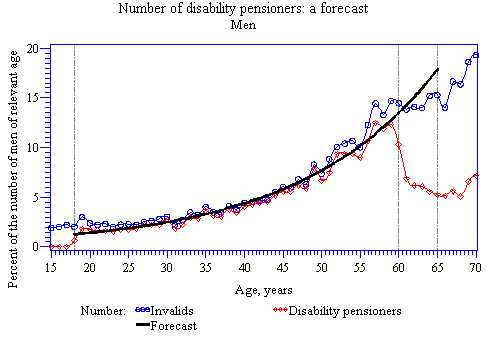
Fig 12
These motives of disabled persons and the previous pension legislation largely determined the age and gender structure of disability pensioners. Fig. 13 presents the age and gender structure of male disability pensioners as percent of the total number of men of relevant age differentiated by disability categories. A noteworthy trend is the rising share of disabled persons with a severe restriction of the capacity for work (categories 1 and 2) in the older ages. However, the rapid increase of the number of disability pensioners among men aged over 70 is most probably determined by past history. This group of pensioners includes the Great Patriotic War veterans who receive two pensions; they constitute 30.3% of all and 60.2% of the male two-pension recipients. True, this category is only 6.2% of all male disability pensioners over 70. For the female disability pensioners, these figures are almost two times lower, equaling 18.5%, 36.1%, and 3.6% respectively.
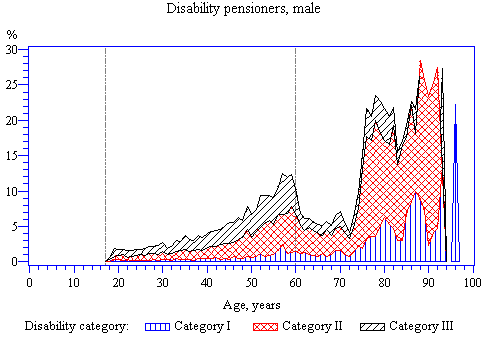
Fig. 13
Under the current pension law, labor pension comprises a basic, and NDC, and a funded part.
The size of the funded and the NDC elements of old-age and disability pensions is determined under practically the same procedure[2] with account of the size of the pension capital (notional or actual) and the expected duration of the payment of labor old-age pension; a supplementary coefficient, K, is factored in when determining the size of disability pension. Upon reaching retirement age, disability pensioners continue to draw their NDC pension, the size of which is determined by (1) the starting size of NDC pension at the date of the outset of its receipt, (2) NDC pension indexation, and (3) contributions for the NDC element of the pension (whenever present) paid during the receipt of the disability pension[3].
This is why, the NDC pension size should not change as a result of switching from a disability to an old-age pension. The formerly common transition from a disability to an old-age pension will not, in the future, make sense; under the new system, there should not be a decrease of the number of recipients of the NDC element of disability pension when retirement age is reached.
The payment of the funded part of labor pension to labor disability pension recipients does not begin before they reach an age entitling them to labor old-age pension. The number of disability pensioners drawing a funded pension is thus determined by the number of disability pensioners of a given age, and should not increase in the future either.
Analysis of the consequences of pension age changes
Let us now analyze the possible change (rise) of retirement age. As was said above, disability and disability pension are concepts whose interrelation depends on the current pension law. This is particularly important in retirement age, when a disabled person has a choice, being able to draw either a disability or an old-age pension. In employable age, the effect of the relevant legislation upon the number of disability pensioners is minimal; the main factor here is the rate of disability onset. This is why, the number of disabled persons and disability pensioners (monotonously) exponentially increases, and the difference between the two groups remains minimal up to retirement age. When retirement age is reached, the old pension system displayed a rapid decrease of the number of disability pensioners, while under the new one, their share will probably remain constant (see above). Retirement age does not really have a connection with the number of disabled persons, which continues to rise under the same exponential law. There is, therefore, every reason to assume that if retirement age is raised, the number of disability pensioners will increase along with the number of disabled persons. Thus, the solid line in Fig. 12 shows a curve, which projects the growth of the share of male disability pensioners if retirement age is raised to 65.
Disabled extra mortality
Another factor affecting the number of disabled persons and, consequently, disability pensioners, is disabled extra mortality. The difference in the mortality of disabled and non-disabled persons was noted by T. Maleva et al[4]. They mentioned that:
· mortality of the disabled who draw a disability pension is significantly higher than of the rest of the population aged under 60; and
· the distinctions become less significant with age.”
The latter reflects the diminishing qualitative differences between the disabled and the non-disabled confirming the hypothesis that “in retirement age, disability has a drastically different character due to situational and motivational factors”. This conclusion is corroborated by our studies of disabled extra mortality. Below, we present the findings of analysis obtained after smoothing the rates of disabled mortality[5] in conformity with the Gompertz law[6]. Fig. 14 shows (for men and women) the excess of annual probabilities of disabled mortality over general mortality of the population as the function of age х. These are the same indicators used in the basic formulae of the model (see Chapter 3).
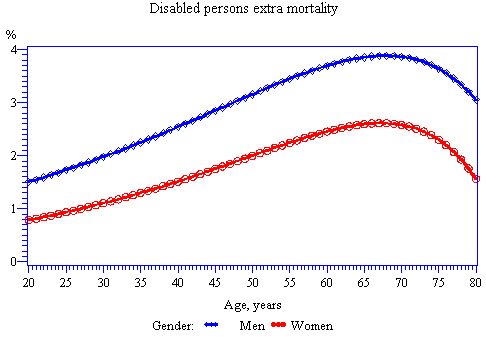
Fig. 14
[1] Insurance Against Industrial Accidents: Actuarial Grounds // Ed. by V.N. Baskakov, Moscow: Akademia, 2001, 192 pp.
[2] # 173-FZ, December 17, 2001.
[3] If there were contributions to the NDC part of the pension, its size may be periodically revised under Paragraph 3, Art. 17 of the Federal Law # 173-FZ, December 17, 2001.
[4] The Disabled in Russia: Disability Causes and Dynamic and the Controversies and Prospects of Social Policy // T.M. Maleva, S.A. Vasin, O.Yu. Golodets, and S.V. Besfamilnykh, Bureau of Economic Analysis, Moscow: ROSSPEN, 1999, 368 pp.
[5] Insurance Against Industrial Accidents: Actuarial Foundations // Ed. by V.N. Baskakov, Moscow: Academia, 2001, 192 pp.
[6] Baskakov, V.N. and Kartashov, G.D., Methodological Instructions for Solving Problems of Actuarial Mathematics (Survival Models), Moscow: Izd-vo MGTU im. N.E. Baumana, 1997, 48 pp.
