



- THE PENSION SYSTEM: A MODEL FOR RUSSIA AND INTERNATIONAL EXPERIENCE
- Modeling the Pension System of the Russian Federation
- 6.3.Non-pensioners
- Modeling the Pension System of the Russian Federation
6.3.Non-pensioners
Government statistics do not refer to the group of persons we define as “non-pensioners”. This is not surprising, since this group is very compositionally heterogeneous, including all the persons under retirement age who do not draw a pension. Specifically, it may embrace children, students, wageworkers, the self-employed, and other groups of persons represented in government statistics. However, only the members of each of these groups who do not draw a pension would belong to the group of non-pensioners
Let us note that it is not difficult to identify the age and gender structure of non-pensioners: it is the difference between total population and the number of pensioners in each age x[1]..
The age and gender structure of female non-pensioners is presented in Fig. 15[2]. Its form in the younger ages is determined by the form of the age and gender structure of the children who receive survivor and social pensions. After the age of 18, most social pensioners disabled in childhood go over to the group of disability pensioners; survivor pensions are stopped at the same age, with the exception of the persons who are in full-time higher education (their pensions are stopped at the aged of 23).
Between the ages of 23 and 35, the share of non-pensioners is relatively stable, varying from 93 to 95% of total population. After 35, the form of non-pensioner age and gender structure is determined by the form of the age and gender structure of old-age pensioners, for the most part emulating its profile. This can be clearly seen in the periods between the legislatively established retirement ages for women, 33, 45, 50, and 55, represented by vertical lines in Fig. 15.
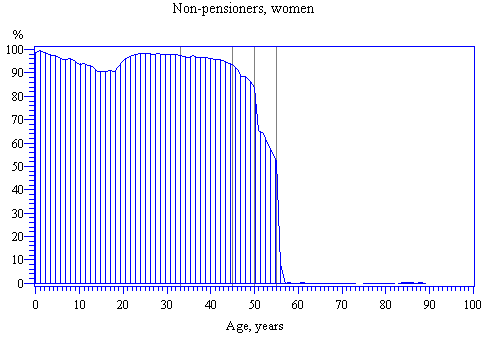
Fig. 15
